
PEGASUS: Police Acquisition and Analysis of Heterogeneous Mass Data to Combat Organized Crime Structures
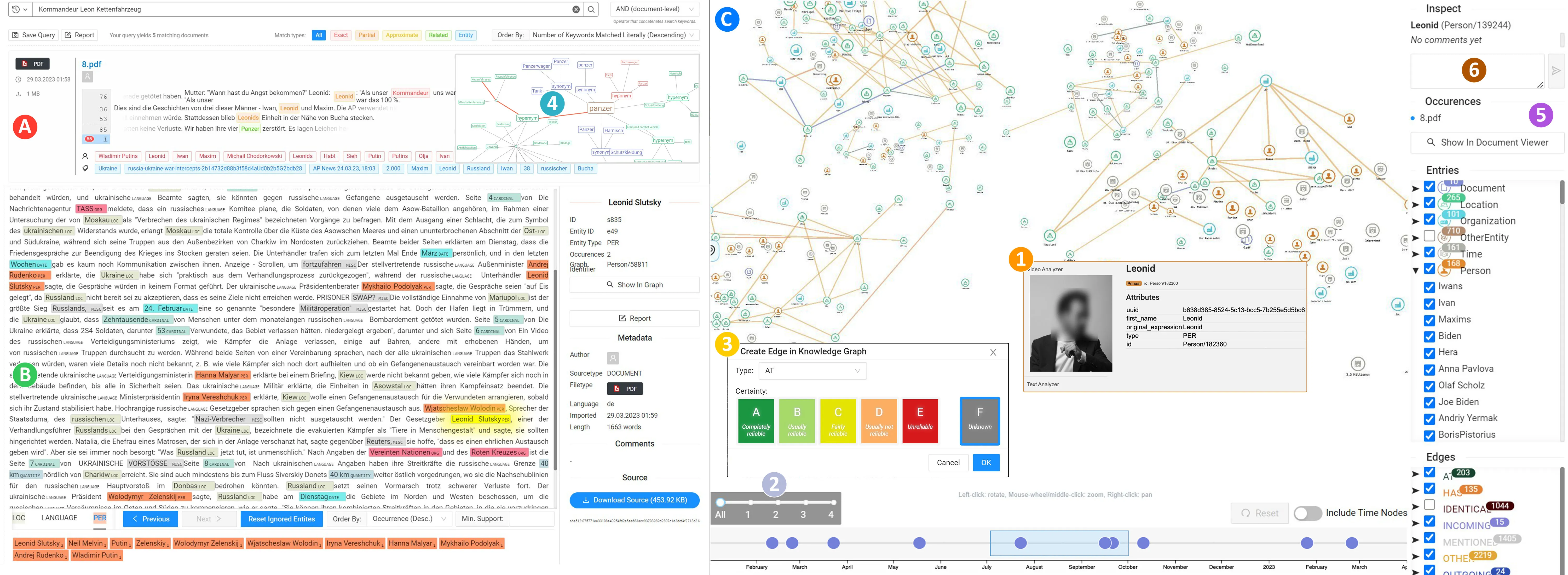
The primary goal of PEGASUS is to support the efficient and effective analysis of large amounts of heterogeneous datasets, integrating the analysis of different data types and put the analysis results into context. To this end, a flexible platform was developed that combines semi-automated analysis, linking, and visualization with modern methods of natural language processing and machine learning - while taking into account legal, ethical, and quality requirements such as traceability, reproducibility, and bias mitigation.
The analysis platform enables the separation of relevant from irrelevant information, the extraction and identification of objects of interest, the discovery of cross-relationships, and semantic data exploration through cross-data-type search queries. Overall, PEGASUS supports data evaluation through a seamless, media-independent view of the data and its case-specific interpretation.
Research Questions
- How can relevant correlations, insights, and structures be efficiently derived from large volumes of heterogeneous data?
- How can a visual analytics framework be designed that integrates data analysis, visualization, and interaction, and enables transparent exploration of complex data?
- What limitations and risks arise in data-driven analytical systems with regard to data protection, data quality, bias, misinterpretations, and potential discriminatory effects?
Selected Results
The University of Konstanz (UKON) contributed semantic text analysis capabilities and supports interactive search using domain-specific ontologies to enable fuzzy text analysis. This facilitates effective knowledge extraction from distributed text data in specialized knowledge management systems, which is visualized using an interactive knowledge graph.
Funding

Federal Ministry of Education and Research
Federal Ministry of Education and Research (BMBF, Germany) in the project PEGASUS (project number 13N15268).